Wednesday, February 8, 2012

Episode 24 February 2nd, 2012

Highbrow! Lowbrow? is back with a fresh new episode. Every two weeks or so, Jesse and Shaun review the top box office earner and Best Picture Academy Award Winner of the same year to see who was right: the critics or the masses. For this episode, we take a look at two fairly similar films from the year 1964: My Fair Lady (Highbrow) and Mary Poppins (Lowbrow).


My Fair Lady, directed by George Cukor, stars Audrey Hepburn as Eliza Doolittle, a common peasant girl, who is taken on by Henry Higgins, a linguistic professor, to be taught correct english and proper manners. Both Jesse and Shaun found this movie disappointing due to its dull atmosphere and unyielding length. Although Hepburn is a strong actress in most rights, this movie doesn't suit her because of her lack of singing ability and her grating cockney accent. While her singing is remedied by the dubbed vocals of Marnie Nixon, the cockney accent which may reflect the intentions of the filmmakers is trying to get through. The general stuffiness and drudgery that surrounds the story (high English society) while being poked at is hard to relate to. The songs lack a certain magic or excitement that really brings someone into the musical atmosphere, maybe too much stage performance and not enough movie magic. The final message of the film isn't really tolerance or growth but rather a begrudging acceptance of each other. This film was too far from our spectrum to really enjoy and the musical elements weren't strong enough to bring us in.


Mary Poppins, directed by Robert Stevenson, stars Julie Andrews as the titular Mary Poppins, a magical nanny who takes care of two impish kids who are being ignored by their workaholic father. They go on a variety of adventures learning about love, life and music with good ole Burt, played by Dick Van Dyke. There is magic abound in this movie from the way Mary Poppins floats in and out of life, to the cartoon lands they visit with penguins and horse races. The songs are certainly catchy although they can be a little overlong and many of the tunes stick with you a while after the film is done. Every character is memorable, even the minor characters from the Naval Captain neighbor to the laughing and giggling Uncle Albert who can't stop floating. Similar to the mixing of live action and animation in Song Of The South, the effect is carried through in Mary Poppins and comes off exceedingly well along with half a dozen other special effects that really create the magic of this movie. Mary Poppins is a childhood classic that stands the test of time, and although not a perfect movie, it still remains fun to watch.

So which film did the Highbrow! Lowbrow? duo end up choosing? The "greatest musical of all time" My Fair Lady or the Disney classic Mary Poppins? Be sure and check out the latest Highbrow! Lowbrow? to find out.

Saturday, January 28, 2012

Episode 23, January 15th 2012

Welcome to another episode of Highbrow! Lowbrow? the podcast where Jesse and Shaun review the Best Picture Academy Award Winner and top box office earner of the same year. We take a fresh look at films new and old to see who was right the critics or the masses. This time, we check out two classic movies from 1975: One Flew Over The Cuckoo's Nest (Highbrow) and Jaws (Lowbrow).


One Flew Over The Cuckoo's Nest, directed by Milos Forman, stars Jack Nicholson as Randall P. McMurphy a prison inmate transferred to a mental hospital who seeks to help the patients rediscover the essence of life they shy away from. Nurse Ratched, played by Louise Fletcher, is the head nurse trying to maintain control over the ward as McMurphy threatens chaos. With a slew of recognized names as patients, from Danny Devito to Christopher Lloyd, it's a real bizarre collection of characters. The strength of this movie is in the ongoing battle between Nurse Ratched and McMurphy, McMurphy trying to free them from their placid lifestyle while Ratched uses it to keep them sane. The joy the patients get from McMurphy's presence is really infectious, and one can see a sincere human effect that he has on his fellow patients. However, McMurphy shows a willful ignorance about who and what his friends are really about. Technically, the film offers little innovation; the score doesn't stand out and the cinematography is serviceable. Still, this film brings you into a unique environment with a unique perspective that manages to be entertaining as well as thought provoking.


Jaws, directed by Steven Spielburg, is the classic thriller movie that starred everyone's favorite monster, Jaws, and spurred a deep seated fear of the ocean in many. Chief Martin Brody, played Roy Scheider, is trying to protect the town of Amity from becoming shark food, enlisting the help of geeky oceanist Matt Hooper, played by Richard Deryfus and grizzled old Quint, played by Robert Shaw. There seemed to be several curious elements of the story, but in the end, they added a unique quirk and humor to the story that helped make it classic. Shaun and Jesse where split on Robert Shaw's Quint: Jesse thought it was over the top, but Shaun dug the swarthy seaman. The legend and terror of the shark is masterfully executed, keeping the creature off screen to build up tension, and a magnificent reveal when you finally see the massive horrifying thing. The music in Jaws is classic John Williams fare, full of adventure and undeniably memorable. It's a classic film that redefined monster movies and the scale with which you could tell them.

So which film did Jesse and Shaun prefer? The meaningful and poignant One Flew Over The Cuckoo's Nest (Highbrow) or the monster movie of the masses, Jaws (Lowbrow)? Tune in and give us a listen to find out!

Monday, January 9, 2012

Episode 22 December 28th, 2011

Here we are again with another episode of Highbrow! Lowbrow? the podcast where Jesse and Shaun review the top box office earner and the Academy Award Best Picture of the same year. Comparing the critical darling and the mass consensus each week, we take a fresh look to see which film we liked more. However, the cinematic epic, 1971's The Godfather won both titles that year, so this time we'll be giving this movie an in depth examination.


The Godfather, directed by Francis Ford Coppola, is the story of the powerful Corleones, a mob family in New York, as power transitions from the respected head of the family Don Vito to his son, Michael. Michael starts out on a more innocent path, but as the responsibilities of the family begin to weigh more on him the more he gets corrupted. The film has a definitive color and lighting scheme giving it a rustic and sincere feel, that really plays to the themes of old Italia and family honor. Speaking of which, family honor and respect stands at the center point of the movie, tying everything together, but bringing a brutal undercurrent to the loyalty it commands. It's through this connection, this responsibility, this love that turns Michael from war hero to mob boss. Though clocking in at 175 minutes (2hours 55 minutes), this movie has a deserved length, an epic film that is deserving of your time and a journey that is worthy to take. All the actors in the film fill their roles spectacularly, bringing real life and uniqueness to the personas that define the family. Al Pacino carries the film admirably, playing Michael's transition subtly but convincingly. Marlon Brando is truly unique as Don Vito Corleone who smart, cunning and brutal, but sincere with the love he has for his family and the respect he commands. The Godfather is a classic film that everyone should watch, if not already have watched, but always deserves another viewing.

Since there was no other movie to compare it to for this episode, we'll yet again advise to watch The Godfather. Be sure to listen to the latest episode of Highbrow! Lowbrow?

Thursday, December 22, 2011

Episode 21, December 20th, 2011

Highbrow! Lowbrow? brings another fresh episode of Jesse and Shaun chopping it up about movies. As we do every week, we review the Top Box Office Earner and Best Picture Academy Award Winner of the same year to see who was right: the critics or the masses. This time we aren't going too far back as we look at the year 2001 and its films, A Beautiful Mind (Highbrow) and Harry Potter And The Sorcerer's Stone (Lowbrow).


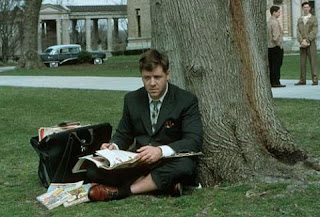
A Beautiful Mind, directed by Ron Howard, is an autobiographical story of Nobel Peace Prize winning mathematician John Nash (played by Russell Crowe) who seeks to do something truly great while battling his inner demons. Nash eventually falls in love with Alicia, a former student played by Jennifer Connelly, who stands by her man against all odds. Both Crowe and Connelly have a somewhat difficult time pulling off these roles, Crowe, a manly man, being a nerdy scientist, and Connelly, being a beautiful woman interested in an awkward and somewhat mean mathematician. There are some fascinating twists and turns to the story that really alter how you see John and his interactions with the world, culminating in a poignant ending both tragic and triumphant. The director Ron Howard has been critiqued as manipulative and his stories saccharine, and for the most part, this film had enough quirks to avoid those pratfalls, however occasionally you do feel the film push you in a certain direction. Overall, this was entertaining throughout, a compelling story about an interesting individual aided by Ron Howard's crowd pleasing direction.


Harry Potter And The Sorcerer's Stone, directed by Christopher Colombus, is the 1st installment of the Harry Potter franchise, based off the adventures of Harry Potter, played by Daniel Radcliffe, and his friends Ron (Rupert Grint) and Hermoine (Emma Watson) as they learn to become wizards while fighting off the evil forces of Voldemort. This film sets up the tenets of the series, establishing the wizard world and introducing us to the main players of the story. Though some of the cgi effects can feel dated, overall this film has a very fantastic, majestic and epic feel due to the sweeping castle shots, nuanced special effects, and imaginative art direction. We both thought that the acting of Grint and Watson were strong, Watson giving a intelligent female hero and Grint hamming it up just enough. But we disagreed on Radcliffe, Harry Potter himself, where Shaun thought Radcliffe was wooden and awkward, Jesse embraced such traits as a part of his nerdy charm and his growing acceptance of this new world. One of the bigger critiques of the film was that it was overlong, taking too much time to get to the arc of the story, a good 10-20 minutes could have been shaven for a leaner and more focused film. Ultimately, t's a worthy 1st installment for the Harry Potter series, combining elements of fantasy, mystery and honor to tell a magical and epic story.

So what film did we end up siding with? The magical adventures of Harry Potter in Harry Potter And The Sorcerer's Stone (Lowbrow) or the tragic trials of John Nash in A Beautiful Mind (Highbrow)? Tune in to the next Highbrow! Lowbrow? to find out!


Friday, December 9, 2011

Episode 20 November 23, 2011

Highbrow! Lowbrow? is back from its month hiatus with a fresh new episode, episode 20 breaking our way into a whole new set of podcasts. As always, we review the Academy Award Best Picture Winner and the top box office earner to try and figure out who was right: the critics or the masses. For this episode, we go back to the year 1961 for our selections: Westside Story (Highbrow) and 101 Dalmatians (Lowbrow). We also take a look at the past 10 episodes and make our picks as to what films really made the cut and what films didn't.


West Side Story, directed by Jerome Robbons and Robert Wise, written by Ernest Lehman and Arthur Laurents and with music by Leonard Bernstein and Steven Sondheim, is a modern retelling of the Romeo and Juliet story, set in 1961 New York. Two star struck lovers, Tony (Richard Beymer) and Maria (Natalie Wood) are caught between the Sharks and the Jets, two gangs with a vicious rivalry. Also starring are Russ Tamblyn as Griff, leader of the Jets, George Chakris as Bernardo, leader of the Sharks, and Rita Moreno as Anita, girlfriend of Bernardo and best friend to Maria. Although this film had a lot of great moments due to the great song and dance numbers, the two main characters, Tony and Maria, were just unlikable and their songs were bland ballads, the film's greatest fault. The two gangs brought many of the memorable moments of the films with songs such as "Officer Krupke," "Cool" and "Jet Song", but they were hard to take seriously as they fought via dance. Other notable songs were "America" with Rita Moreno delivering a strong performance, and "Tonight" providing a strong ensemble performance leading into the intermission. Despite the movie's flaws and it's unwieldy length, West Side Story remains entertaining and enjoyable because of the exciting dance numbers and catchy tunes.


101 Dalmatians, directed by Clyde Geronimi, is another Disney animated classic, featuring Pongo, a dalmatian, and his girlfriend, Perdita, as they try and rescue 99 other dalmatians from the aptly named Cruella De Vil. Featuring the songs of Mel Leven and the voice talents of Rod Taylor, J. Pat O'Malley, and Betty Lou Gerson. The Disney hit making machine brings catchy tunes, memorable characters, and great stories to this film, continuing it's long standing tradition. The film also benefits from it's brief runtime, a svelte 79 minutes, that keeps the pace well without overdrawing the movie. That's not much else to say except that it's a classic disney film with all the elements that only Disney could execute so well, not to mention a great film for kids.

So what film did we end up choosing: 101 Dalmatians or West Side Story? Tune in and check out the latest episode of Highbrow! Lowbrow? to find out. Also stick around to see what we choose for our favorite picks over these past 10 episodes.

Monday, October 24, 2011

Episode 19 October 9th, 2011

Welcome to another episode of Highbrow! Lowbrow? the movie review podcast where Shaun and Jesse compare the Top Box Office Earner and the Best Picture Academy Award Winner of the same year. We take a look at the critical consensus and the mass appeal to try and get to the heart of what makes a movie really great. The year we look at is 2006 and the films we discuss are Pirates of the Caribbean: Dead Man's Chest (Lowbrow) and The Departed (Highbrow).


The Departed, directed by Martin Scorsese, stars Matt Damon and Leonardo Dicaprio as two sides of the same coin, both young up and comers in the police department. However, they both are insiders on opposing organizations, Damon an informant for the gangster Frank Costello (played by Jack Nicholson), Dicaprio a snitch for the undercover unit lead by Queenan (played by Martin Sheen). There are a lot of big performances in this film, most notably Jack Nicholson as the devilish Frank Costello, who revels in his debauchery. Dicaprio is able to keep up with everyone else by playing the heart of this movie with a fiery passion. Alec Baldwin, Mark Wahlberg and Martin Sheen all deliver strongly in this film with strong characters and big attitudes. Matt Damon plays a convincing foil to Dicaprio, a more leveled and cool character, who portrays his conflict underneath, trying to justify his role in all the mayhem. Scorses finally scored the Best Picture Award for this film, more of a recognition of his storied career. Despite the movie clocking in at 151 min, the time isn't felt due to the deft editing and exciting pacing of the story. This is yet another strong outing from a legendary director who brings all the elements together to make a truly great film that can be enjoyed by many.

Pirates of The Caribbean: Dead Man's Chest, directed by Gore Verbinski, has Captain Jack Sparrow, played famously by Johnny Depp, searching for the heart of Davy Jones to control the seas, while William (Orlando Bloom) and Elizabeth (Kiera Knightley) try to reunite and live happily ever after. Though Depp plays Sparrow with a classic zeal, this movie still feels like more of the same. The plot can be pretty convoluted and hastily explained where you're left wondering what really is going on. To make up for the that, they pile on the effects and the action to almost a ridiculous level, but at a certain point you just begin to tune out. Although there are fun action sequences and impressive effects, the lackluster story and overloaded visuals are wearisome.

So what film did we end up siding with? The visual effects feast of Pirates Of The Caribbean: Dead Man's Chest or the gritty crime thriller The Departed? Be sure to tune in and check out the latest Highbrow! Lowbrow? to find out.


Friday, October 7, 2011

Episode 18 September 27th. 2011

Here's another episode of Highbrow! Lowbrow? the movie review retrospective, taking a look at the Top Box Office Earner and the Best Picture Academy Award Winner of the same year. With each episode, we seek to figure out who was right that year: the masses or the critics. This time we're hitting the Lowbrow pretty hard with Billy Jack up against the Highbrow but gritty crime thriller The French Connection, both from 1971.


The French Connection, directed by William Friedkin, stars Gene Hackman as rough cop Jimmy "Popeye" Doyle together with Roy Schneider as Det. Buddy Russo on the chase of drug czars with a french connection. This film was expertly directed by Friedkin as he brought a real rawness keeping the camera handheld throughout and shooting guerilla style (without permits). It really adds to the intensity of the most memorable scene of the movie the car-train chase, in which Hackman barrels through New York chasing a subway train through traffic. Hackman as Doyle is fantastic, a true badass, but really calls into question the idea of bad cop. The French Connection is a great action thriller that can be enjoyed viscerally but has enough layers to be stimulate intellectually.


Billy Jack, directed by and starring Tom Laughlin as Billy Jack, a half Indian, hapkido expert and Green Beret who roams the land protecting the local school for outcast children from the evil backward ways of the townspeople. This movie is the definition of a so bad it's good film, with unintentional comedy abound. Tom Laughlin is on a quest to spew his message of peace and love while also getting to kick butt in this film. From the hippie school doing improv acts to the redneck bad guys, it's all just a train-wreck of free love and people power. If your a fan of films such as The Room or Plan 9 From Outer Space, be sure to check out Billy Jack.

So what film ultimately won our hearts in the end? The bounty of treasures that is Billy Jack or the no nonsense gruffness of The French Connection? Check out the latest Highbrow! Lowbrow? to find out!